Showing posts with label taxidermy. Show all posts

Friday, September 5, 2014

Prey Taxidermy


I ran into Allis Markham of Prey Taxidermy on Instagram because of the @taxidermybabes feed (which is awesome). I was immediately struck by the fact that she is living my dream. She works for the Los Angeles Natural History Museum doing taxidermy work and works with Tim Bovard (Master Taxidermist). I was in awe. Her Instagram feed is absolutely amazing as well (@allis) I sent her a message hoping that I'd get some of my questions answered, and, after a few days, I got back the most wonderfully detailed email from her. Every interaction with her has been absolutely amazing and she is just wonderful.

In an article recently written by Lauren Herstik for the LA Weekly, the importance of museums in preserving history is called to attention, "...The Natural History Museum itself plays a crucial role in preserving taxidermy. Museums are the only place where practitioners have the opportunity to work on most specimens; as employees of a public institution, museum taxidermists are exempt from laws restricting the sale, trade and possession of endangered and protected species. The complex regulations include the Migratory Birds Treaty of 1918, which restricts the "taking" of wild birds, criminalizing the whole pursuit all the way down to being in possession of a feather."


Tim Bovard goes on to explain how taxidermy has changed so much in the past century. "The Natural History Museum of Los Angeles County is unique among its peers in that it's the only such museum in the country with a full-time taxidermist on its payroll. "No other institution that started building dioramas in the '20s has continuously had diorama people on staff."

I am so excited to meet the both of them in the coming months. It's been my dream since I was a child staring up at the Tyrannosaurus and Triceratops fighting in the main entry way to get a tour of the museum from those who work there. 

The whole article can be found here

Monday, September 1, 2014

Taxidermy + Why It's Important


If you've been following my Instagram feed for a long time (iseegodinbirds_) you know that I've been a taxidermy apprentice for nearly six months now. Taxidermy is slowly coming back into the mainstream, and it's good to see that it is. For a long time, it was very controversial. Many museums were looked down upon for having extensive taxidermy halls on display and many of them took much of it down in order to appease the public.

I want to work in a museum as a curator or preparator one day, and I can tell you exactly why taxidermy is one of the most important things to a museum. It is not about having the biggest collection anymore. The days of having thousands of the same birds in one museum is gone. What is not gone is the need for different samples in genetic variation and the ability to see slight, wonderful evolutionary shifts over time. Darwin's Finches, but more importantly his mockingbirds, showed how birds evolved to fit their environments. By taking specimens back to England, it allowed him to really look into what these animals were specialized for.

Via
Via
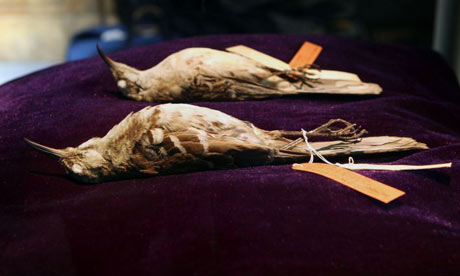
Both of the above pictures are samples of Charles Darwin's original specimens that he collected while in the Galapagos Islands. That means these birds are from between 1831 and 1836, making them between 178-183 years old. These animals whose lives were taken nearly 200 years ago have revolutionized science in so many ways.

"Extinction is a different kind of death. It's bigger..." -Steward Brand

Another great example is extinction within the Holocene, or modern, era. Human beings have been such a destructive force in the world, and we have had a role in wiping certain animals off of the face of the planet. Here's a list of a few examples:

  • the Dodo Bird
  • the Thylacine or Tasmanian Tiger
  • the Passenger Pigeon
  • the Great Auk
  • the Quagga
  • the Moa
  • the Falkland Island Wolf
  • the Zanzibar Leopard
  • the Caribbean Monk Seal
  • the Carolina Parakeet
  • the Atlas Bear
  • the Toolache Wallaby
  • the Sea Mink
  • the Bubal Hartebeest
  • the Stellar's Sea Cow
The thing about most of these animals is that they are alive still. Not in a sense that we can think of them up and moving around, but their lives live on in taxidermy. And using taxidermy and genetic sequencing, they very well may be brought back to life one day.
Thylacine skull, and skinned head via


Taxidermied thylacine- source unknown

Taxidermied Great Auk, via

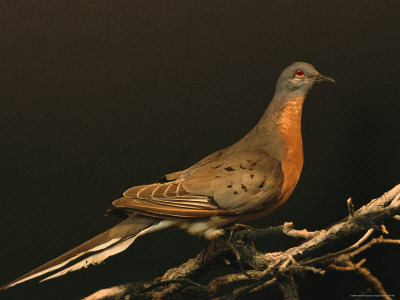
Passenger Pigeon, source unknown
Quagga mare and foal, via
These animals still have pieces of their genetics locked up inside of them. Through gene sequencing, these animals may one day again walk the earth.

Here's a really great TED talk by the aforementioned Steward Brand on what they're doing to bring back the Passenger Pigeon.